

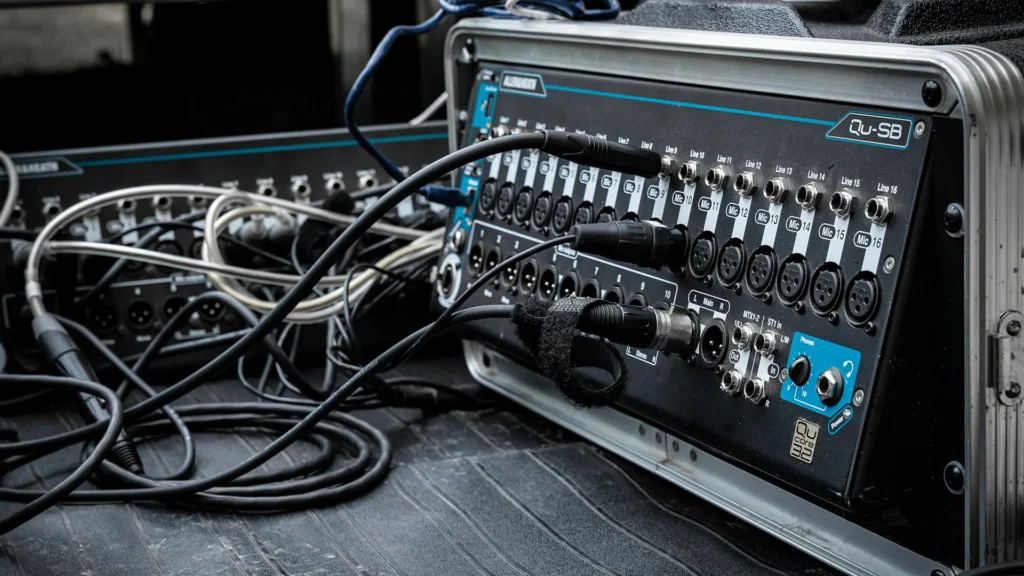
A large stage might have dozens of microphones that all need to reach the audio system somewhere else in the room.
Running a bunch of long XLR cables for every one would get really messy, really fast.
That is where an audio snake comes in. It gives the crew a cleaner way to move many audio signals between the stage and the mixing system, whether that happens through a traditional analog multicore cable or a modern digital connection.
Once you understand that basic job, the rest of it starts to make total sense.
The easiest way to understand an audio snake
Start with one microphone. A person talks into it. That microphone sends an audio signal down an XLR cable.
Now put eight microphones onstage. Then 16. Then 32.
At some point, running an individual cable from every microphone all the way across a ballroom becomes a mess.
An analog audio snake solves that by combining many individual audio lines into one larger cable.
At the stage end, you have a box with 16, 24, 32, or more XLR inputs. Microphones plug into that box.
Inside the snake, those individual signals travel through separate conductors bundled inside the same larger cable.
At the other end, the signals break back out so they can connect to the mixing console.
Same microphones. Same audio signals.
What is a stage box?
The box sitting onstage is called a stage box.
It gives the crew a convenient place to plug in microphones, direct boxes, playback devices, and other audio sources.
Instead of every cable disappearing across the floor toward front of house, short microphone cables can run to a stage box nearby.
That helps keep the stage cleaner and makes troubleshooting easier.
If microphone 12 has a problem, the audio crew can trace it to input 12 instead of following a 150-foot XLR cable through a pile of other cables.
The basic idea still exists with modern digital systems. What changed is what happens after the signal gets there.
An analog snake is exactly what it sounds like
Traditional analog snakes carry each audio channel as an analog signal through the multicore cable.
If you have 32 microphone inputs, the snake needs the wiring to carry those 32 individual signals.
That can make large analog snakes thick, heavy, and not especially fun to wrestle through a venue.
In most situations, there is absolutely nothing wrong with using one.
Analog audio is straightforward. You plug a microphone into one end, connect the corresponding channel at the other, and you have a physical path between them.
A digital snake changes the middle of the trip
A digital snake approaches the same problem differently.
Instead of carrying dozens of analog microphone signals through dozens of individual copper paths all the way to the console, the system converts the audio to digital near the stage.
Those digital channels can then travel over a much smaller cable.
In many systems, that cable is Cat5e, Cat6, or another Ethernet-style cable.
This is where live audio starts looking a little more like computer networking.
The stage box may contain microphone preamps and analog-to-digital converters. Once the signals are digital, many channels can travel together over the same connection to the console or another audio device.
The result is pretty dramatic.
A thick analog multicore snake can be replaced by a cable that looks a lot like the one connected to your office computer.
One important catch: a Cat cable does not automatically mean Dante
This is where terminology gets confusing.
Several manufacturers use Cat5e or Cat6 cable for their own digital audio transport systems.
Allen & Heath, for example, has used protocols such as dSNAKE, DX, and gigaACE to connect consoles with remote audio I/O.
Those cables may physically look like Ethernet cables, but that does not necessarily mean the audio is traveling over a normal Ethernet network.
So if somebody points at a Cat cable and says, “That must be Dante,” they might be right. They also might not be.
The connector does not tell you the whole story.
So where does Dante fit in?
Dante takes the digital-audio idea and puts it on an IP network.
Instead of creating one dedicated point-to-point connection between a stage box and a console, Dante-enabled devices can send and receive audio across an Ethernet network.
A stage box can put microphone channels onto the Dante network.
The front-of-house console can receive them.
A recording computer might receive the same channels.
Another console could receive some of them for a broadcast mix.
Audio can be routed between compatible devices through the network rather than being physically tied to one destination.
That flexibility is a big reason Dante has become so common in professional AV.
Audinate, the company behind Dante, has a deeper explanation of how Dante networks move audio over Ethernet.
Is Dante an audio snake?
Kinda.
Dante itself is not a physical snake or stage box. It is an audio-over-IP platform used to transport audio between compatible devices over a network.
But Dante can absolutely perform the job an audio snake traditionally performed.
A Dante-enabled stage box can take microphone signals onstage, convert them to digital audio, and send them over the network to the console.
So when people say “Dante snake,” they usually mean a system using Dante to move those stage inputs to wherever they need to go.
The old job still exists. The transportation system changed.
Why would you want the microphone preamps near the stage?
In many digital systems, the microphone signal reaches a stage box before traveling very far.
That means the analog signal can be amplified and converted to digital near the source.
From there, the digital audio handles the long trip through the venue.
The front-of-house engineer can often control those stage-box preamps remotely from the console.
Turn up the gain at FOH and the actual preamp being controlled may be sitting 100 feet away backstage.
That is one of those things that sounds like magic until you remember we have been remotely controlling computers for decades.
Audio finally got tired of carrying the heavy cable.
One network can send audio to more than one place
This is where networked audio becomes especially useful on larger events.
Those live event microphones may need to feed several destinations at once:
- The front-of-house audio console
- A separate broadcast or livestream mix
- Recording equipment
- Backstage monitoring
With an old analog system, splitting and distributing those signals requires additional hardware and cabling.
A networked system can route digital audio to multiple compatible destinations much more flexibly.
That does not mean every production should throw every signal onto one giant network and hope for the best.
Network design, clocking, bandwidth, routing, redundancy, and configuration still matter.
Dante makes powerful things possible, but someone still has to build it correctly.
Digital does not mean “one cable runs the whole show”
This is another easy misconception.
Yes, a single network cable can carry many channels of digital audio.
That does not mean every large event should depend on one lonely cable running across the ballroom.
Critical systems may use redundant network paths. Fiber can be used for longer distances or between locations. Network switches may be distributed around a venue.
A complex event might have Dante connecting multiple audio positions, stage boxes, wireless systems, intercom, recording systems, and other equipment.
Do live events still use analog snakes?
Absolutely. Sometimes analog is the easiest solution.
A small breakout room with a handful of microphones does not necessarily need an audio network.
A short run between a stage box and a nearby mixer may be perfectly easy to handle with analog cable.
There are also situations where simple analog connections are useful as backups, interfaces between systems, or quick ways to solve a problem.
Newer does not automatically mean better for every job. The useful question is not, “Can we use Dante here?”
It is, “What is the cleanest and most reliable way to get these audio signals where they need to go?”
Why planners usually do not need to worry about any of this
If you are planning a corporate event, you probably do not need to specify an analog snake, digital snake, Dante stage box, or network topology.
Your production team should be the one with the knowledge to handle that.
What you do need to communicate is what the event needs to accomplish.
How many people are speaking? Are there panels?
Will audience members ask questions? Are there breakout rooms?
Does the livestream need its own audio mix? Is the event being recorded?
Are multiple rooms connected?
Those answers tell the audio team what signals need to exist and where they need to go.
Then we can figure out which audio system and infrastructure is necessary.
The snake never really disappeared
The funny thing is that live events still need exactly what they needed decades ago.
A microphone onstage has to somehow reach the audio engineer, we just have much better ways of doing it now.
Sometimes that path is an analog cable, and other times it is a manufacturer-specific digital snake.
Sometimes it is a Dante network carrying dozens or hundreds of audio channels around a venue.
The technology has changed, but the basic job is wonderfully boring:
Get the right audio from point A to point B.
Everything else is how we choose to do it.
Planning an event with a lot of audio?
MeyerPro supports corporate events with microphones, wireless systems, Dante networks, audio consoles, stage boxes, recording, broadcast audio, and live event AV services in Seattle, Portland, and beyond.